
Email:info@yinsopack.com
Phone:+86 15014837000
Welcome to Dongguan Yinso Medical Packaging Co.,Ltd.
Welcome to Dongguan Yinso Medical Packaging Co.,Ltd.


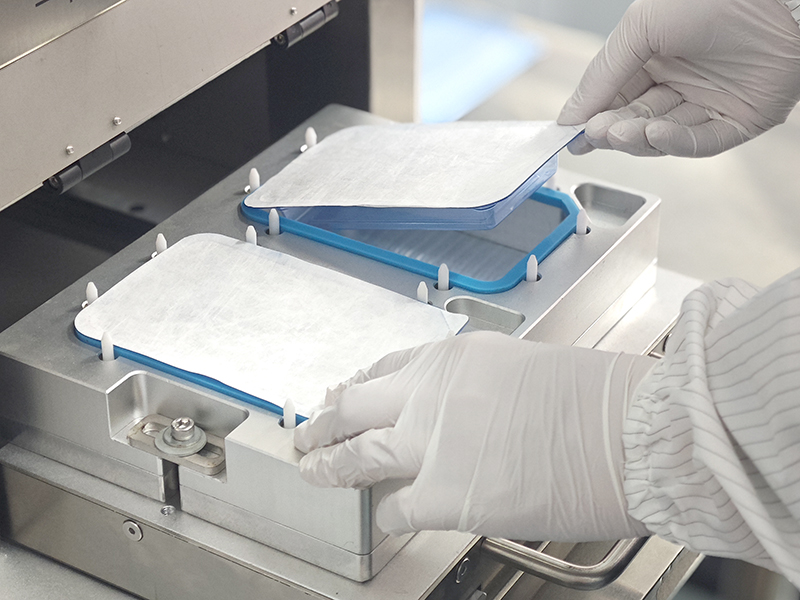
In medical blister tray packaging, packaging serves not only as the "outer garment" of products but more importantly as a Sterile Barrier System (SBS) ensuring patient safety. This system maintains the sterility of medical devices and drug-device combination products throughout their lifecycle—from production to use—preventing contamination and secondary injuries, thereby serving as the first line of defense in medical safety.
The mainstream medical blister tray formats include:
Medical dialysis bags
Medical blister trays + lid materials
Automatic blister packaging
Among these, medical blister tray + lid material combinations are widely used for high-end medical devices (e.g., implants, surgical instruments) and Class III medical devices (e.g., cardiovascular stents, orthopedic instruments) due to their superior protective properties and convenience.
The sterile barrier system is formed when lid materials are heat-sealed to blister trays, followed by sterilization. Ideal heat sealing must meet four critical requirements:
Seal strength compliance: Per EN 868-5:2018, adhesive-coated paper must achieve ≥1.5N/15mm without fiber tear
Continuous adhesive transfer: Visual inspection shows no breaks in adhesive application
Absence of micro-channels: Validated through dye penetration tests
Clean peelability: Ensures medical staff can open packaging without contamination risk
However, production environments present multiple challenges to heat sealing reliability. Below are five common heat sealing failure modes with corresponding solutions to optimize packaging processes.
Problem: Non-uniform adhesive transfer to medical blister tray, resulting in incomplete seals
Potential causes:
Contaminated sealing surface (mold release agents, glove residues)
Uneven sealer tooling surface (causing localized pressure variations)
Suboptimal sealing parameters (temperature/pressure/duration)
Solutions:
Surface cleaning: Wipe sealing surface with alcohol-soaked lint-free wipes
Tooling calibration: Verify and adjust sealer tooling flatness (laser-based flatness testing recommended)
Parameter optimization: Implement step-sealing (e.g., low-temperature pre-press followed by optimal sealing temperature)
Problem: Lid material delamination leaves paper residue on medical blister tray, compromising sterility
Potential causes:
Excessive sealing parameters (over-temperature/pressure/duration)
Poor lid design (e.g., full-perimeter sealing causing stress concentration)
Material incompatibility (e.g., insufficient fiber strength)
Solutions:
Parameter adjustment: Reduce temperature/pressure to balance strength and openability
Lid design optimization: Create unsealed margins (≥2mm edge buffer) and stepped structures (tray height differentials to reduce tear risk)
Material upgrade: Switch to high-strength adhesive-coated Tyvek® or medical composite films
Problem: Medical blister tray edge warping affects package integrity and sterilization compatibility
Potential causes:
Excessive sealing parameters causing thermal deformation
Structural/material inconsistencies (wall thickness variations, additive effects)
Solutions:
Reduce sealing parameters
Optimize medical blister tray design
Problem: Internal condensation appears in intact packages after transportation
Potential causes:
Extreme temperature/humidity fluctuations
Insufficient lid material breathability
Solutions:
Use high-breathability lid materials
Conduct simulated transport testing
Problem: Medical blister tray edges separate after ethylene oxide (EO) sterilization, breaching barrier integrity
Potential causes:
Gas shock during aeration (over-stacking or insufficient ventilation)
Surface contamination reducing bond strength
Solutions:
Optimize sterilization cycle parameters
Clean sealing surfaces: Remove contaminants with alcohol wipes
Enhance lid material breathability
info@yinsopack.com
+86 15014837000(Wechat/WhatsApp/Skype)
NO.59 Meilin Road, Dalingshan Town, Dongguan City,Guangdong Province, China
Get a Free Prototype + Compliance Report Within 5 Days
Yinso Packing has been a leading figure in the medical packaging industry since 2007. We are committed to providing reliable, cost - effective, and innovative rigid thermoformed packaging solutions to top medical companies.
© 2025 Dongguan Yinso Medical Packaging Co.,Ltd All Rights Reserved.
AddressNO.59 Meilin Road, Dalingshan Town, Dongguan City,Guangdong Province, China
Emailinfo@yinsopack.com
Tel(Wechat/WhatsApp/Skype)+86 15014837000
About Us Medical Blister Packs Products Capabilities Blogs Contact Us


